
Infection

The Infection section is led by Gennaro de Pascale.
INF News


WhatsApp Community
If you want to stay up to date with everything happening within the Infection Section, join the WhatsApp Community here.
RESOURCES
EDUCATION
Courses
Sepsis, Severe Infections and Stewardship pathway
Level 1: Foundations in Sepsis and Severe Infections
Level 2: Consolidating Clinical Practice
Level 3: Developing Expert Practice
Webinars and Podcasts
Webinars
– Optimising antibiotic therapy in COVID-19 patients
– sCAP: Are we ready for the winter?
– SSC Webinar 1: infection management
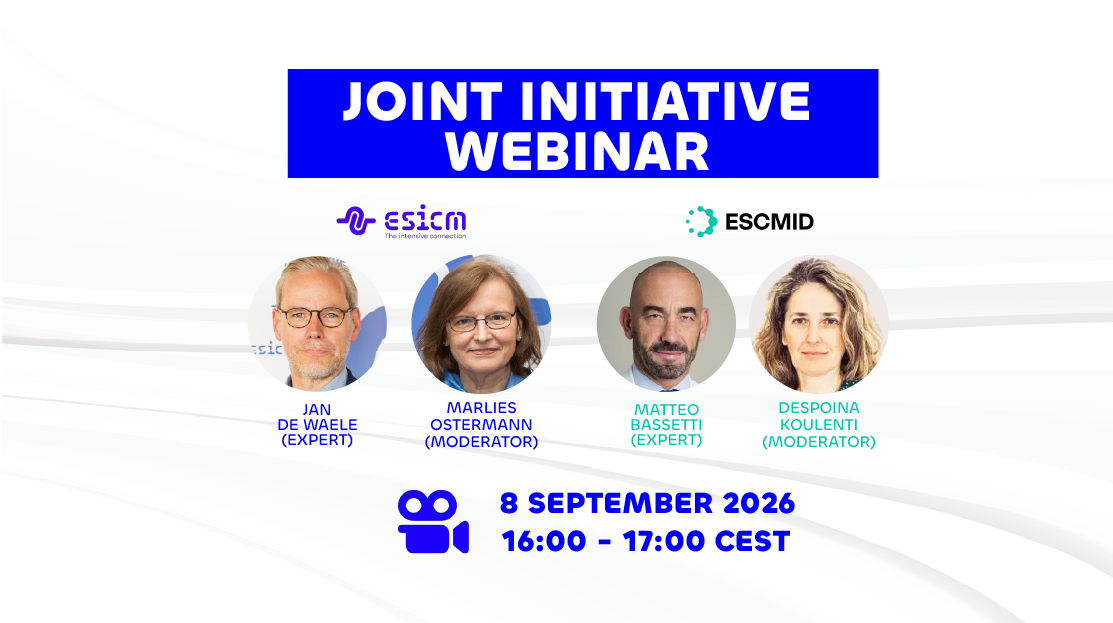
– Sepsis in Immunosuppressed Patients: Pathophysiology, MDR Risk, and IgM-Enriched Therapy
– Hantavirus webinar
– Antibiotics in the ICU – the Scandinavian perspective
– Antimicrobial Stewardship in ICU – Why we need it?
Podcasts
– Biomarkers in Severe Infections and Sepsis – Moving from Trials to the Bedside
– Dose Optimisation in the ICU: The Role of TDM and Model-Based Solutions
– How to use biomarkers of infection or sepsis at the bedside
– Management of severe bronchiolitis in infants <12 months old admitted to paediatric ICU
– Guidelines for the management of severe community-acquired pneumonia
– Results from the UNITE-COVID study
Free webinars and podcasts are available for members & non members on LIVES-STREAM.
Use your ESICM credentials or create an account
RESEARCH
Projects
In Development
DALI-2
The continuation of DALI study aiming to define β-lactam concentration levels in ICU patients and their impact on patient outcome.
PIs: Jason Roberts, Paul Williams, Jeffrey Lipman
Ongoing
SKIN-ICU
A retrospective observational study of antimicrobial use across ESICM nations, with the investigation of variation by type of ICU and antimicrobial resistance.
PIs: Fredrik Sjövall / Jeroen Schouten
AB-ICU
A retrospective observational study of antimicrobial use across ESICM nations, with the investigation of variation by type of ICU and antimicrobial resistance.
PIs: Fredrik Sjövall / Jeroen Schouten
Surveys
– Current strategies of antifungal prophylaxis, preemptive and empirical antifungal treatment in abdominal surgery (SURG-MYC Survey)
Guidelines and consensus statement
2024
– Bassetti, M., Giacobbe, D.R., Agvald-Ohman, C. et al. Invasive Fungal Diseases in Adult Patients in Intensive Care Unit (FUNDICU): 2024 consensus definitions from ESGCIP, EFISG, ESICM, ECMM, MSGERC, ISAC, and ISHAM. Intensive Care Med 50, 502–515 (2024).
2023
– Martin-Loeches, I., Torres, A., Nagavci, B. et al. ERS/ESICM/ESCMID/ALAT guidelines for the management of severe community-acquired pneumonia. Intensive Care Med 49, 615–632 (2023).
2022
– Paul M., Carrara E., Retamar P. et al., European Society of Clinical Microbiology and Infectious Diseases (ESCMID) guidelines for the treatment of infections caused by multidrug-resistant Gram-negative bacilli (endorsed by European society of intensive care Medicine). Clinical Microbiology and Infection, Volume 28, Issue 4, 521 – 547.
Relevant Literature
- Nseir, S., Salluh, J.I.F. & Póvoa, P. Update on infection: from prevention to diagnosis and management. Intensive Care Med 52, 545–547 (2026).
- Dequin, PF., Torres, A., Bassetti, M. et al. Severe community-acquired pneumonia: current concepts and controversies. Intensive Care Med 52, 118–130 (2026).
- Hérault, A., Vangheluwe, L., Alexandre, K. et al. Urinary tract fungus balls in an immunocompromised patient with persistent candida albicans fungemia. Intensive Care Med 52, 178–180 (2026).
- Dequin P.F. et al. CRICS-TriGGERSep Network. Hydrocortisone in Severe Community-Acquired Pneumonia. N Engl J Med. 2023 May 25;388(21):1931-1941. doi: 10.1056/NEJMoa2215145. Epub 2023 Mar 21. PMID: 36942789.
- Kreitmann L. et al. Relationship between immunosuppression and intensive care unit-acquired colonization and infection related to multidrug-resistant bacteria: a prospective multicenter cohort study. Intensive Care Med. 2023 Feb;49(2):154-165. doi: 10.1007/s00134-022-06954-0. Epub 2023 Jan 2. PMID: 36592202.
- SuDDICU Investigators for the Australian and New Zealand Intensive Care Society Clinical Trials Group; Effect of Selective Decontamination of the Digestive Tract on Hospital Mortality in Critically Ill Patients Receiving Mechanical Ventilation: A Randomized Clinical Trial. JAMA. 2022 Nov 15;328(19):1911-1921. doi: 10.1001/jama.2022.17927. PMID: 36286097; PMCID: PMC9607966.
- Fish M. et al. REMAP-CAP Immunoglobulin Domain UK Investigators. Coronavirus disease 2019 subphenotypes and differential treatment response to convalescent plasma in critically ill adults: secondary analyses of a randomized clinical trial. Intensive Care Med. 2022 Nov;48(11):1525-1538. doi: 10.1007/s00134-022-06869-w. Epub 2022 Sep 14. PMID: 36102943; PMCID: PMC9472738.
- Ewoldt T.M.J. et al. Model-informed precision dosing of beta-lactam antibiotics and ciprofloxacin in critically ill patients: a multicentre randomised clinical trial. Intensive Care Med. 2022 Dec;48(12):1760-1771. doi: 10.1007/s00134-022-06921-9. Epub 2022 Nov 9. PMID: 36350354; PMCID: PMC9645317.
- Bloos F. et SepNet Study Group. (1 → 3)-β-D-Glucan-guided antifungal therapy in adults with sepsis: the CandiSep randomized clinical trial. Intensive Care Med. 2022 Jul;48(7):865-875.
- Bouglé A. et iDIAPASON Trial Investigators. Comparison of 8 versus 15 days of antibiotic therapy for Pseudomonas aeruginosa ventilator-associated pneumonia in adults: a randomized, controlled, open-label trial. Intensive Care Med. 2022 Jul;48(7):841-849.
- Meduri G.U. et ESCAPe Study Group. Low-dose methylprednisolone treatment in critically ill patients with severe community-acquired pneumonia. Intensive Care Med. 2022 Aug;48(8):1009-1023.
- Kousathanas A. et al. Whole-genome sequencing reveals host factors underlying critical COVID-19. Nature. 2022 Jul;607(7917):97-103.
- WHO Solidarity Trial Consortium. Remdesivir and three other drugs for hospitalised patients with COVID-19: final results of the WHO Solidarity randomised trial and updated meta-analyses. Lancet. 2022 May 21;399(10339):1941-1953.
- Jarvis J.N. et al. Ambition Study Group. Single-Dose Liposomal Amphotericin B Treatment for Cryptococcal Meningitis. N Engl J Med. 2022 Mar 24;386(12):1109-1120.
- Hagel S. et al. TARGET Trial Investigators. Effect of therapeutic drug monitoring-based dose optimization of piperacillin/tazobactam on sepsis-related organ dysfunction in patients with sepsis: a randomized controlled trial. Intensive Care Med. 2022 Mar;48(3):311-321.
- Gangneux J.P. et al. Fungal infections in mechanically ventilated patients with COVID-19 during the first wave: the French multicentre MYCOVID study. Lancet Respir Med. 2022 Feb;10(2):180-190.
- Darkoh C. et al. Emergence of Clinical Clostridioides difficile Isolates With Decreased Susceptibility to Vancomycin. Clin Infect Dis. 2022 Jan 7;74(1):120-126.
- Peters-Sengers H. et al. MARS consortium. Source-specific host response and outcomes in critically ill patients with sepsis: a prospective cohort study. Intensive Care Med. 2022 Jan;48(1):92-102.
- Meghraoui-Kheddar A. et al. Two New Neutrophil Subsets Define a Discriminating Sepsis Signature. Am J Respir Crit Care Med. 2022 Jan 1;205(1):46-59.
Article Reviews
Ventilator-associated complications in patients with ESBLE infections
Reducing CRBSIs in ICUs: What’s the best strategy?
Hospitals in 11 European countries were computer-randomised to receive one of three interventions in the Prevention of Hospital Infections by Intervention and Training (PROHIBIT) project.
Prevention and Control of Multidrug-Resistant Gram-Negative Bacteria in ICUs
This Systematic Review of Clinical Studies compared Prevention & Control interventions for Multidrug Resistant Gram-Negative Bacteria in adults admitted to ICUs including RCTs, Cohort Studies, Interrupted time-series studies and before-and-after studies.
Invasive Candida infections
Invasive Candida infections are leading causes of mortality among critically ill patients. The diagnosis of such diseases is challenging and a delayed start of the appropriate antifungal therapy was associated with a poor prognosis.
Optimising Infection Care
ICU environment requires existing antimicrobial agents to be used more judiciously with the aim at the reduction of antimicrobial resistance.
Evaluating new antibiotic therapy endpoints
Antimicrobial resistance is a growing problem in medicine.