
Rehabilitation & PICS
The Rehabilitation & PICS section is led by Stefan Schaller.
Rehabilitation & PICS News

WhatsApp Community
If you want to stay up to date about everything happening within the Rehabilitation & PICS section, join the WhatsApp Community here.
Please contact the Section Chair (2025-2027: Stefan Schaller, +43 1 40400-41020) with any questions related to the Section.
History
The Section Rehabilitation & PICS (PICS = Post Intensive Care Syndrome) was applied in Summer 2025 by Prof. Stefan Schaller and approved by the Executive Committee and the Council on 26 October 2025.
Activities & Focus Areas
The Section meets regularly to develop, support, and share scientific and educational initiatives, including: multicentre research on ICU-acquired weakness, cognitive and emotional sequelae, frailty, and long-term functional outcomes; implementation frameworks for early mobilisation in the ICU; long-term follow-up and survivorship programmes (including digital health); development and harmonisation of standardised outcome measures and core datasets for recovery and PICS/PICS-F research; and contribution to ESICM educational activities throughout the year and at LIVES.
Resources
Infographics
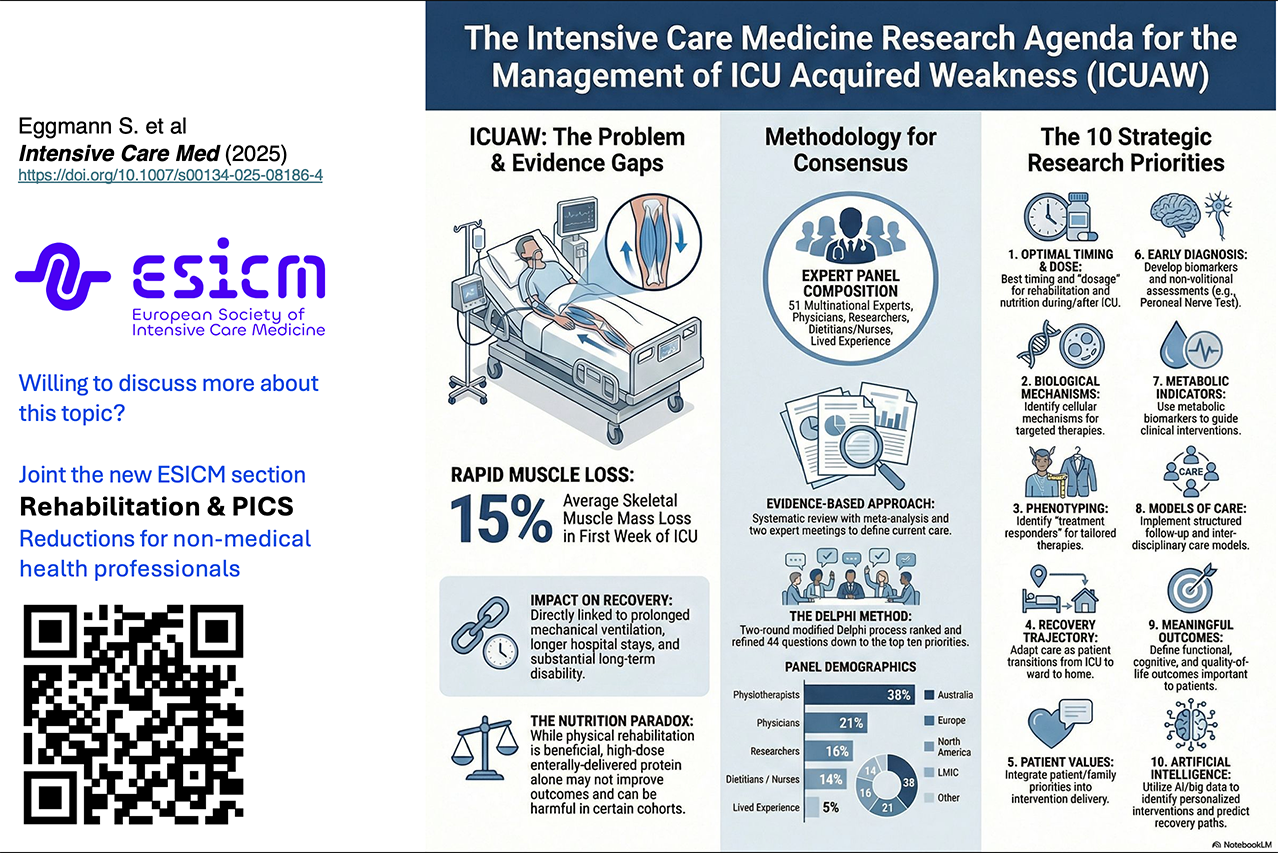
This multinational consensus report outlines a strategic roadmap to address ICU-acquired weakness (ICUAW), a condition associated with rapid muscle loss during critical illness.
While structured physical rehabilitation is supported by current evidence, recent trials show that high-dose enteral protein alone does not improve outcomes and may be harmful in some patients.
The report defines key research priorities for the coming years, emphasizing a shift toward precision medicine through personalized nutrition and exercise (dosing and timing), the use of AI and big data, and patient-centered recovery models spanning from the ICU to home.
Global collaboration is essential to transform ICUAW into a manageable condition.
Member contributor: Dr Cheryl Hickmann
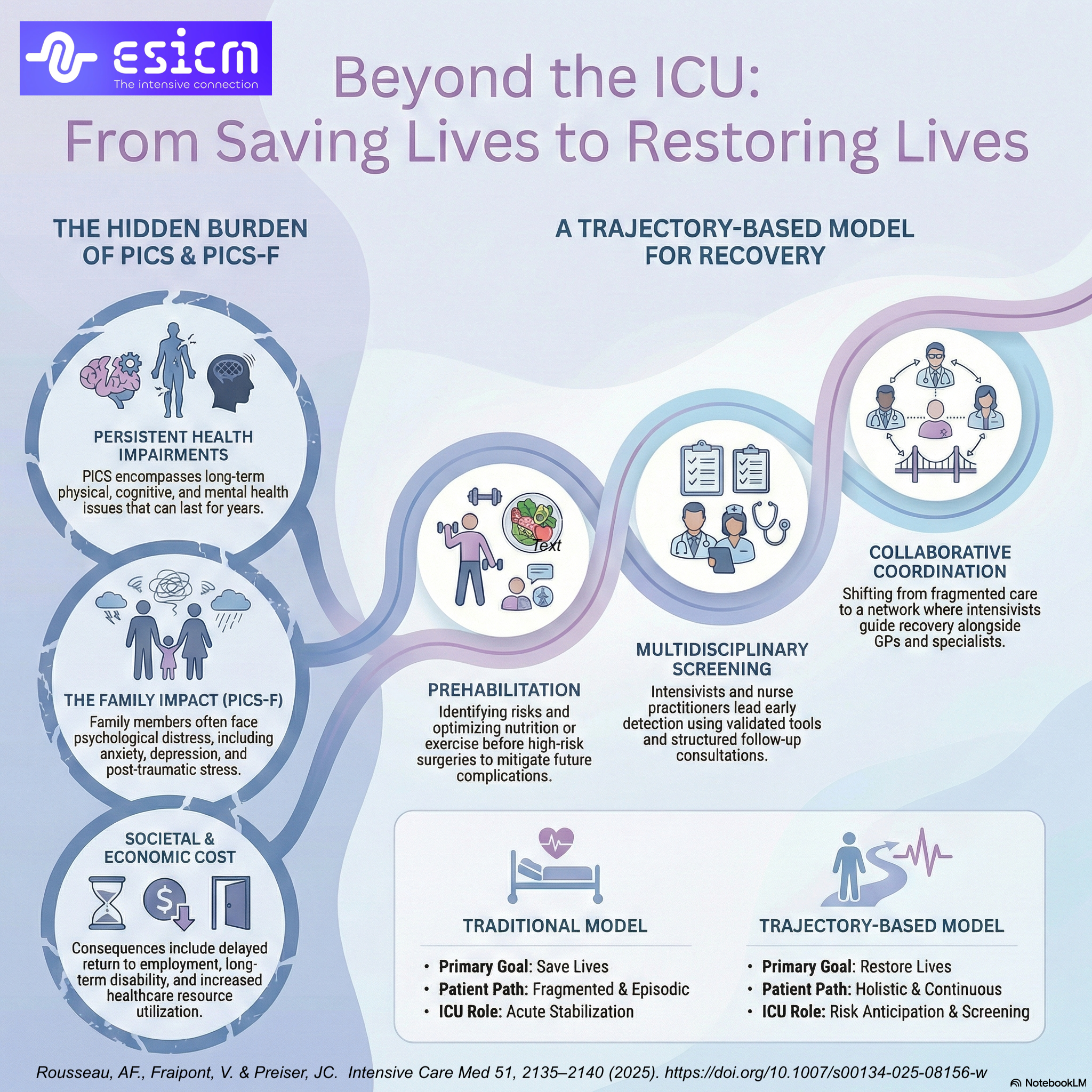
Intensive care is entering a new era.
Survival is not enough. Post-Intensive Care Syndrome (PICS) affects patients and families long after ICU discharge, with lasting physical, cognitive, and psychological consequences.
In this recent paper, Rousseau, Fraipont & Preiser (2025) argue that intensivists must take an active role in recovery — from early identification of PICS to coordinated rehabilitation and follow-up.
Post-intensive care syndrome is a potential consequence of critical care: can intensivists afford to look away? (Intensive Care Medicine)
Member contributor: Dr Cheryl Hickmann
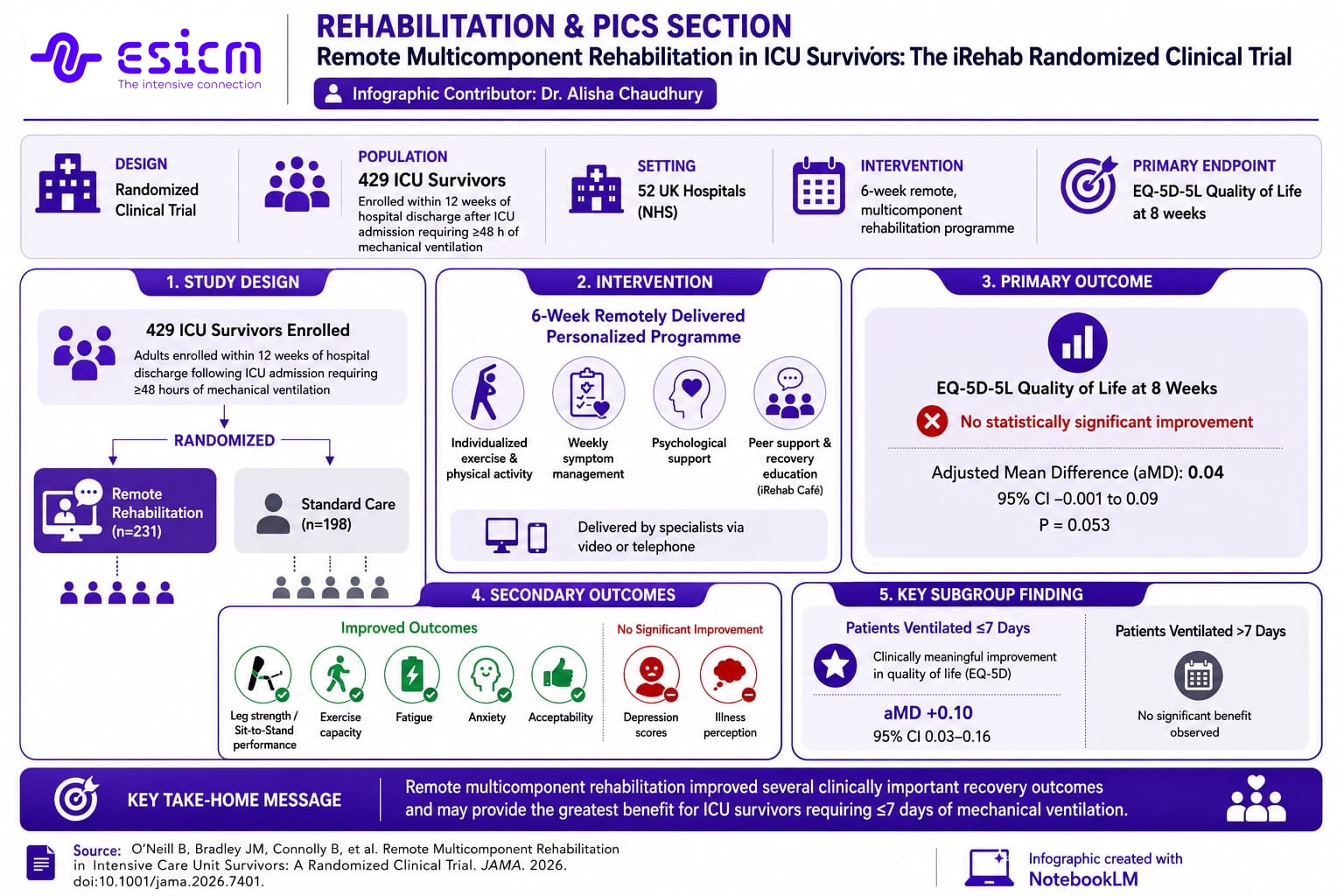
Can rehabilitation after critical illness be effectively delivered remotely?
The iRehab Trial offers encouraging evidence that a structured 6-week remote, multicomponent rehabilitation program for ICU survivors is both feasible and beneficial.
Key findings:
– The primary endpoint (health-related quality of life at 8 weeks) narrowly missed statistical significance.
– Participants demonstrated significant improvements in physical strength, fatigue, and anxiety.
– Benefits became more apparent at 6 months, with meaningful improvements in quality of life.
– Patients requiring 7 days or fewer of mechanical ventilation appeared to derive the greatest benefit.
These findings reinforce that recovery after critical illness extends well beyond hospital discharge. While early improvements in global quality of life may be difficult to demonstrate, targeted rehabilitation can meaningfully improve important patient-centered outcomes and support long-term recovery.
Member contributor: Dr Alisha Chaudhury
Useful Links
- Functional measurements: https://www.improvelto.com/
- Mobilization Network: https://mobilization-network.org/category/icu-care/
- Resources of the ICU Rehab Network: https://icurehabnetwork.org/resources/
Education
Webinars and Podcasts
Webinars
– Post Intensive Care Syndrome
– Improving comfort and safety in the ICU
– COVID-19 N&AHP Marathon Webinar – the three ‘R’s: Rehabilitate, Recover, Reflect – Part 1
Podcasts
– Prehabilitation in the ICU
– Unmet Needs in PICS: Are We Measuring What Matters?
Free webinars and podcasts are available for members & non members on LIVES-STREAM.
Use your ESICM credentials or create an account
Research
Projects
MAPPING PROJECT
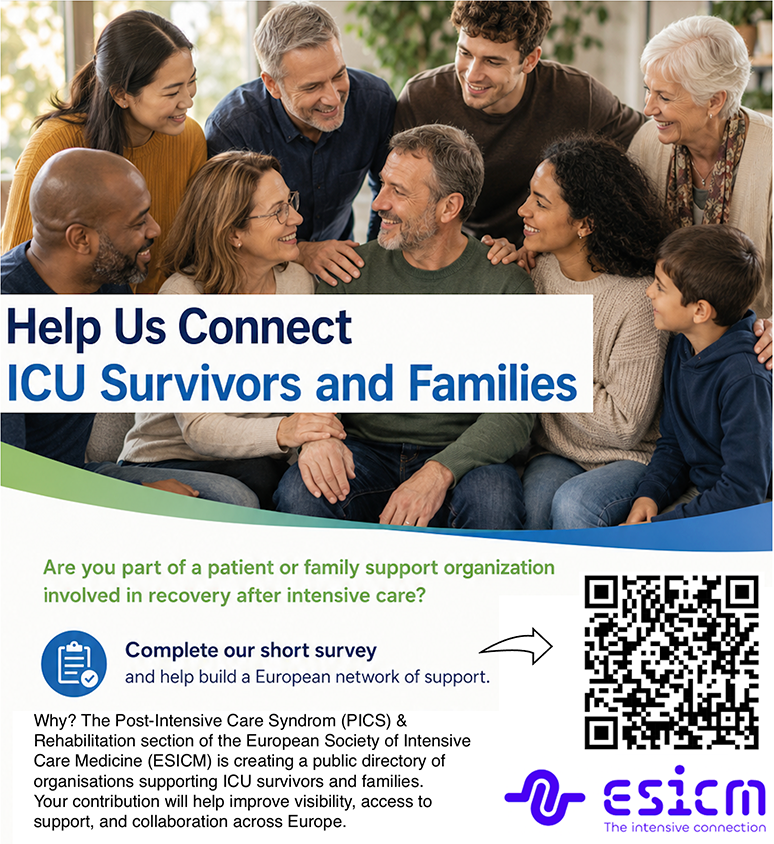
Patients and families often face lasting physical, cognitive, and emotional challenges after an ICU stay. Yet access to structured follow-up and support remains uneven across Europe.
The ESICM Rehabilitation & PICS section is launching a mapping exercise to identify patient and family organisations involved in post-ICU recovery. The goal is to create a public directory, improve visibility, and help survivors and families find support in their local context.
We invite colleagues, national intensive care societies, and community partners to help by sharing the survey and identifying relevant organisations in their countries.
Together, we can strengthen collaboration, improve access to support, and better connect communities working in post-ICU recovery.
ERUPT
ESICM-endorsed study: Early rehabilitation of intensive care unit patients – a multinational prospective observational study on dosage and outcome. Schaller – International Recruiting starting Jan 2026
PICS-DACH
This is a research consortium of the German speaking countries (DE, CH, AT) investigating PICS risk factors and PICS. Weiß – Consortium built, Patient recruiting starting Q1 2026.
Guidelines and consensus statement
2025
Australian clinical practice guideline for physical rehabilitation and mobilisation in adult intensive care units. Australian guideline on early mobilization – 2025. https://www.australiancriticalcare.com/article/S1036-7314(25)00065-7/fulltext
2024
Schaller, S.J., Scheffenbichler, F.T., Bein, T. et al. Guideline on positioning and early mobilisation in the critically ill by an expert panel. Intensive Care Med 50, 1211–1227 (2024). https://doi.org/10.1007/s00134-024-07532-2
2023
Renner, C., Jeitziner, MM., Albert, M. et al. Guideline on multimodal rehabilitation for patients with post-intensive care syndrome. Crit Care 27, 301 (2023). https://doi.org/10.1186/s13054-023-04569-5
2022
S2e Guideline on Multimodal Neurorehabilitation Concepts for Post-Intensive Care Syndrome (PICS) – 2022. https://register.awmf.org/de/leitlinien/detail/080-007
2021
– Robba, C., Wong, A., Poole, D. et al. Basic ultrasound head-to-toe skills for intensivists in the general and neuro intensive care unit population: consensus and expert recommendations of the European Society of Intensive Care Medicine Intensive Care Med 47, 1347–1367 (2021). https://doi.org/10.1007/s00134-021-06486-z
– Instruments to measure outcomes of post-intensive care syndrome in outpatient care settings – Results of an expert consensus and feasibility field test. Weiß – 2021. https://journals.sagepub.com/doi/10.1177/1751143720923597
2020
Vlaar, A.P., Oczkowski, S., de Bruin, S. et al. Transfusion strategies in non-bleeding critically ill adults: a clinical practice guideline from the European Society of Intensive Care Medicine. Intensive Care Med 46, 673–696 (2020). https://doi.org/10.1007/s00134-019-05884-8
Relevant Literature
Post-intensive care Syndrome (PICS)
• Rousseau AF, Leaver S, Cardoso T, Eggmann S, Guidet B, Hermann M, Hickmann CE, McWilliams D, Ostermann M, Piva S, Stoppe C, van Mol M, De Waele J, Weiss B, Beil M, Schaller SJ. BEYOND PICS: a conceptual framework for post-ICU recovery stewardship. Crit Care. 2026 Aug (in press)
• Schaller S, Cardoso T, Eggmann S, Hermann M, Hickmann CE, Naef R, van Mol M, Piva S, Rodriguez-Ruiz E, Sadjadi M, Tiboldi A, Wiegele M, Van den Berghe G, McWilliams D, Weiss B. Rehabilitation and the post-intensive care syndrome across the recovery continuum: a narrative review. Intensive Care Med. 2026 Aug (in press)
• Chadda KR, Puthucheary Z. Persistent inflammation, immunosuppression, and catabolism syndrome (PICS): a review of definitions, potential therapies, and research priorities. Br J Anaesth. 2024 Mar;132(3):507-518. doi: 10.1016/j.bja.2023.11.052. Epub 2024 Jan 4. PMID: 38177003; PMCID: PMC10870139.
• Chadda KR, Blakey EE, Davies TW, Puthucheary Z. Risk factors, biomarkers, and mechanisms for persistent inflammation, immunosuppression, and catabolism syndrome (PICS): a systematic review and meta-analysis. Br J Anaesth. 2024 Sep;133(3):538-549. doi: 10.1016/j.bja.2024.03.038. Epub 2024 Apr 30. PMID: 38688799; PMCID: PMC11347813.
Post-intensive care Syndrome-Family (PICS-F)
• Regalado BC, Alvarelhão JJM, Simões JFFL. Exploring the association between family needs and clinical status in intensive care unit patients: a cross-sectional study. J Res Nurs. 2026 Aug 23:17449871261456573. doi: 10.1177/17449871261456573. Epub ahead of print. PMID: 42643491; PMCID: PMC13503640.
• Ito Y, Suzuki M, Hamaguchi T, Otaka Y, Asai M, Sakaguchi Y, Shirai Y, Yoshikawa E, Tateno A, Miyawaki I, Yokobori S. Identification of unmet information needs among families of critically ill patients and their association with postintensive care syndrome-family: A single-centre cross-sectional study. Aust Crit Care. 2026 Aug 27;39(5):101679. doi: 10.1016/j.aucc.2026.101679. Epub ahead of print. PMID: 42659699.
• Trotta F, Bartoli D, Gravante F, Meucci B, Alvaro R, Vellone E, Pucciarelli G. Quality of Life in Intensive Care Unit Survivors-Family Member Dyads: A Conceptual Framework and Longitudinal Study Protocol. Nurs Crit Care. 2026 Sep;31(5):e70635. doi: 10.1111/nicc.70635. PMID: 42586790; PMCID: PMC13467667.
Pediatrics PICS
• Christian E, Williams S, Husband ST, Brown A, Sabobeh M, Schwartzberg S, Hendrix E, Locket S, Trone D, Featherston J, Kalyanasundaram S, Gorantla S, Alam M, Cai Z, Pan H, Ghafoor S. Beginning Restorative Activities Very Early: A Quality Improvement Project to Advance ABCDEF Bundle Practice in a Pediatric Oncology Intensive Care Unit. Pediatr Rep. 2026 Jul 22;18(4):99. doi: 10.3390/pediatric18040099. PMID: 42646644; PMCID: PMC13516045.
Intensive Care Unit Acquired Weakness & Rehabilitation
• Eggmann, S., Parry, S.M., Broadley, T. et al. The intensive care medicine research agenda for the management of ICU acquired weakness: a multinational, interprofessional perspective. Intensive Care Med 51, 2199–2212 (2025). https://doi.org/10.1007/s00134-025-08186-4
• Trotta F, Bartoli D, Gravante F, Meucci B, Alvaro R, Vellone E, Pucciarelli G. Quality of Life in Intensive Care Unit Survivors-Family Member Dyads: A Conceptual Framework and Longitudinal Study Protocol. Nurs Crit Care. 2026 Sep;31(5):e70635. doi: 10.1111/nicc.70635. PMID: 42586790; PMCID: PMC13467667.
• O’Neill B, Bradley JM, Connolly B, et al. Remote Multicomponent Rehabilitation in Intensive Care Unit Survivors: A Randomized Clinical Trial. JAMA. 2026;336(3):236–247. doi:10.1001/jama.2026.7401
• Eggmann S, Bear DE, Bourne RS, Freeman-Sanderson A, Hickmann CE, Karner V, McWilliams D, Needham DM, Singer P, van Mol M, van Zanten A, Hodgson CL, Schaller SJ. Key principles for rehabilitation of critically ill patients with obesity. Intensive Care Med. 2026 Jul 17. doi: 10.1007/s00134-026-08541-z. Epub ahead of print. PMID: 42467246.
• Arancibia-Ramirez N, Contreras YJ, Silva A, Damiani LF, Molina J, Hickmann CE. Association between fluid balance, muscle strength, and muscle quality in critically ill patients: a retrospective observational study. Intensive Care Med Exp. 2026 Aug 28;14(1):115. doi: 10.1186/s40635-026-00966-6. PMID: 42663781; PMCID: PMC13525138.
• Hiser SL, Casey K, Nydahl P, Hodgson CL, Needham DM. Intensive care unit acquired weakness and physical rehabilitation in the ICU. BMJ. 2025 Jan 27;388:e077292. doi: 10.1136/bmj-2023-077292. PMID: 39870417.
• Schmidbauer ML, Dimitriadis K. Intensive Care Unit Acquired Weakness as a Modifiable Organ Dysfunction? A Narrative Review of Evolving Diagnostic and Therapeutic Concepts. Nutrients. 2026 Mar 3;18(5):820. doi: 10.3390/nu18050820. PMID: 41829990; PMCID: PMC12987148.
• Eggmann S, Paton M, Villinger C, Bradley S, Hellings T, Hills A, Venetz P, Broadley T, Charles-Nelson A, Hodgson C. Responsiveness and the minimal clinically important difference of the Chelsea Critical Care Physical Assessment tool (CPAx) in critically ill, mechanically ventilated adults: a study protocol for a prospective, multicentre, cohort study. BMJ Open. 2025 Sep 18;15(9):e102374. doi: 10.1136/bmjopen-2025-102374. PMID: 40973373; PMCID: PMC12458801.
• Bai X, Gu C, Li Y, Jin X, Liu J, Guo C. Best Evidence Summary on Early Exercise for Prevention of ICU-Acquired Weakness: An Evidence-Based Synthesis. J Multidiscip Healthc. 2026 Feb 17;19:574831. doi: 10.2147/JMDH.S574831. PMID: 41737368; PMCID: PMC12927820.
• Aysha ZM, Abdelmalik MAA, Mohamed SA, Abdallah MAB. Effects of Integration Sedation Interruption With Early Mobility on Patient Outcomes and Prevention of Intensive Care Unit-Acquired Weakness in Critically Ill Ventilated Patients. Crit Care Nurs Q. 2026 Oct-Dec 01;49(4):342-358. doi: 10.1097/CNQ.0000000000000626. Epub 2026 Aug 26. PMID: 42659654.
• Gremese G, Comuzzi M, Danielis M, Piani T, Biasucci DG, Cuttone G, Fittipaldi C, Lucchese F, Vetrugno L, Deana C. Inflammation Course and Skeletal Muscle Wasting Correlation During the First Week in ICU: A New Approach for Personalised Feeding of Critically Ill Patients? J Pers Med. 2026 Jul 30;16(8):409. doi: 10.3390/jpm16080409. PMID: 42645903; PMCID: PMC13514688.
• La Via L, Cuttone G, Misseri G, Senussi Testa T, Paternò DS, Pappalardo F, Patroniti N. Contemporary Sedation Strategies for Mechanical Ventilation: Balancing Patient Outcomes, Delirium Prevention, and Early Recovery. Respiration. 2026 Aug 21:1-15. doi: 10.1159/000550984. Epub ahead of print. PMID: 42627775.