
ICMx – Article of the week
Sex-related differences in lung injury distribution and outcomes in COVID-19 acute respiratory failure: insights from the CT-COVID19 multicenter study group
Authors: Davide Signori, Alice Nova, Yi Xin, Sarah E. Gerard, Aurora Magliocca, Giovanni Vitale, Linda Mussoni, Jonathan Montomoli, Matteo Subert, Alessandra Ponti, Savino Spadaro, Giancarla Poli, Francesco Casola, Roberta Garberi, Andrea Restivo, Davide Raimondi Cominesi, Marco Giani, Vanessa Zambelli, Giuseppe Foti, John G. Laffey, Maurizio Cereda, Emanuele Rezoagli and for the CT-COVID19 Multicenter Study Group
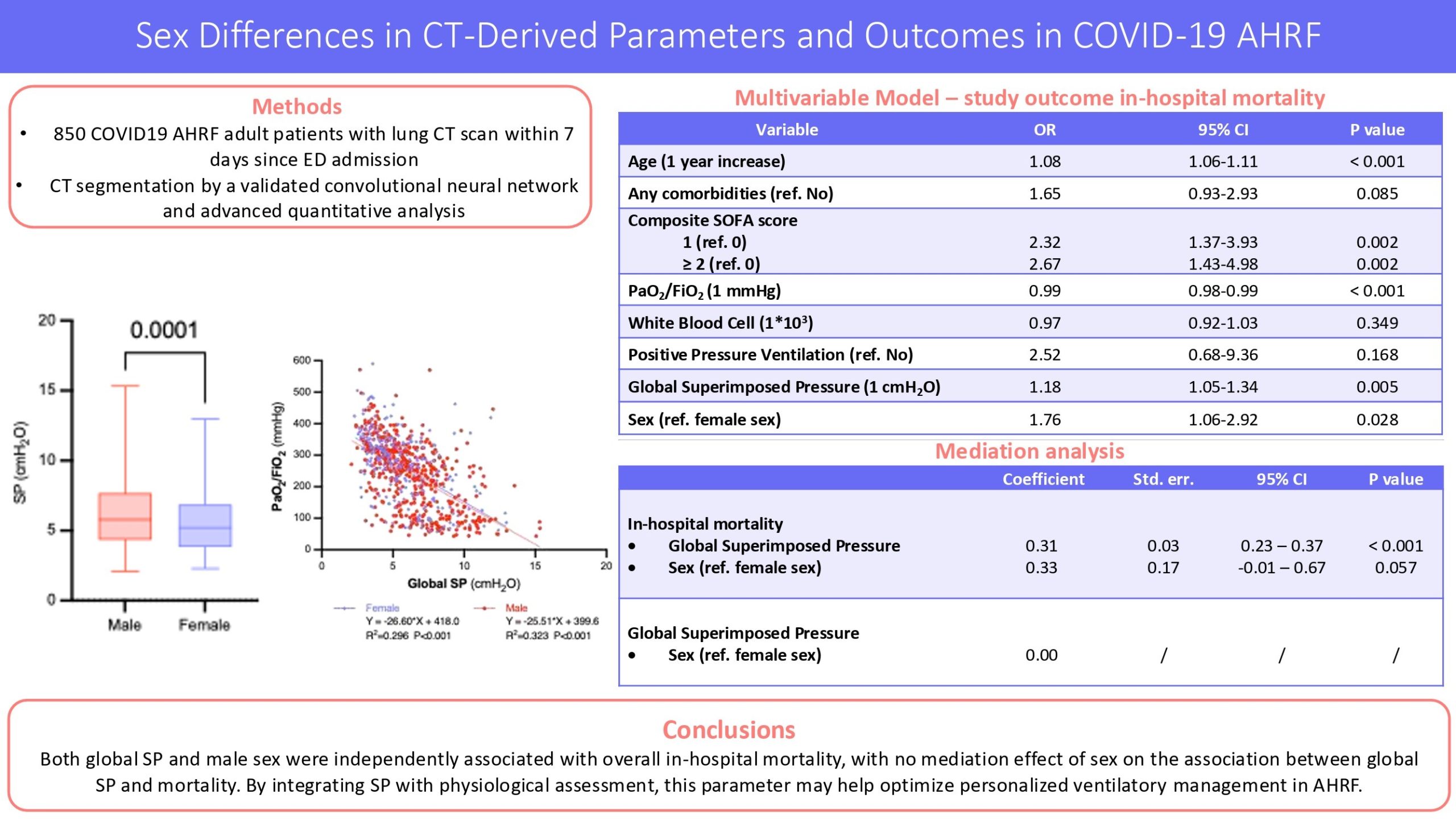
Sex-related differences have been consistently reported in patients with acute hypoxemic respiratory failure and COVID-19; however, the contribution of lung morphology to these disparities remains unclear. In this multicenter retrospective cohort study, quantitative chest CT analysis was performed in spontaneously breathing patients with COVID-19-related acute hypoxemic respiratory failure at hospital admission to assess lung density, volume, mass, and superimposed pressure, a CT-derived estimate of gravitational stress. Male patients exhibited larger lung volumes, greater lung mass, and higher global superimposed pressure compared with females, despite similar proportions of ground-glass opacities and consolidation. Multivariable analysis identified older age, lower PaO₂/FiO₂ ratio, higher SOFA score, increased global superimposed pressure, and male sex as independent predictors of mortality. Mediation analysis demonstrated that the association between superimposed pressure and mortality was not mediated by sex. These findings suggest that male patients experience a greater gravitational lung load and mechanical disadvantage, while both male sex and superimposed pressure independently contribute to mortality risk in COVID-19-related acute hypoxemic respiratory failure.