
ICMx – Article of the week
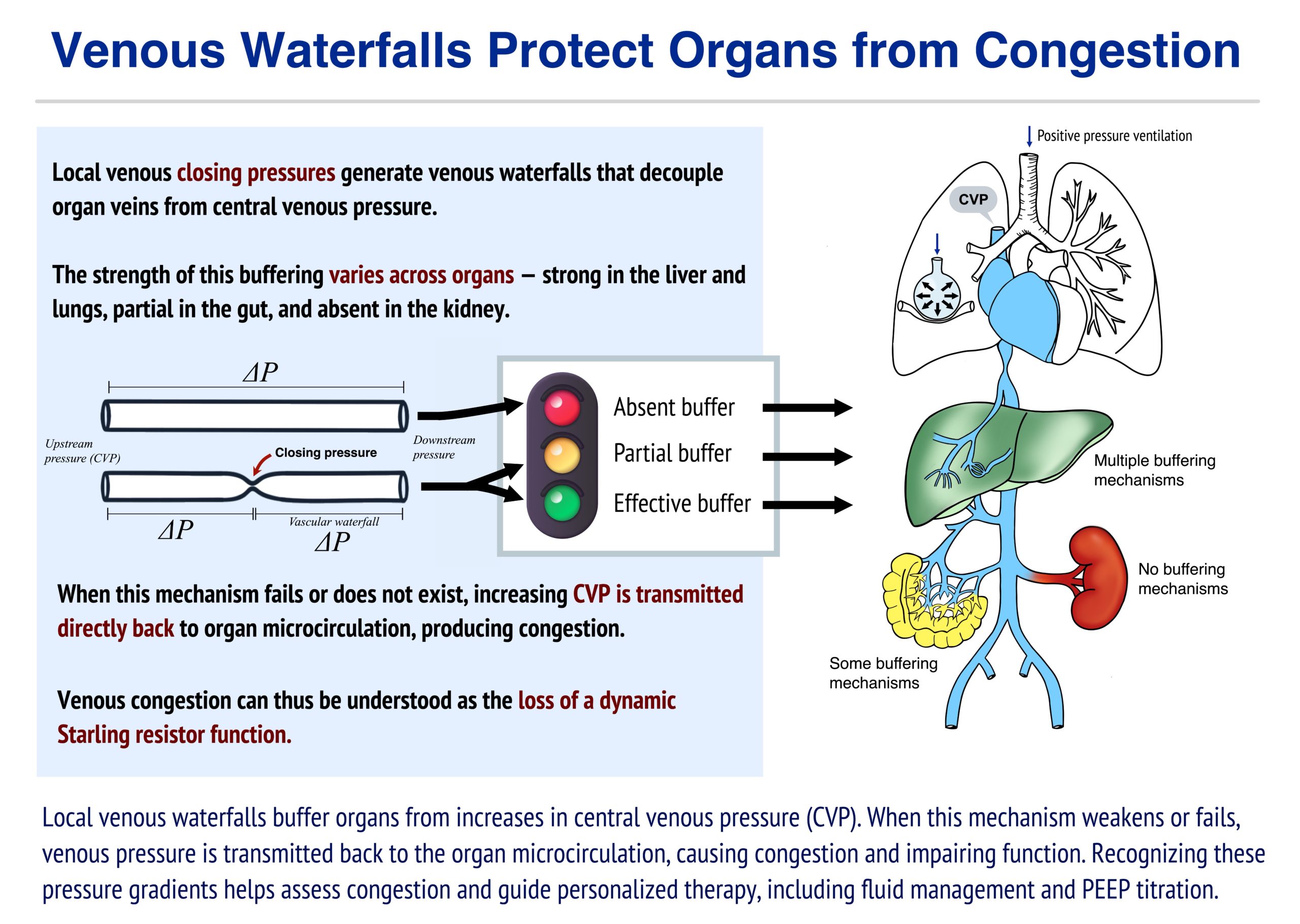
Venous congestion from a vascular waterfall perspective: reframing congestion as a dynamic Starling resistor phenomenon
Authors: Ricardo Castro, Eduardo Kattan, Jaime Retamal, Glenn Hernández & Michael R. Pinsky
This review revisits the vascular waterfall phenomenon, utilising Starling resistor principles, and describes how blood flow becomes independent of downstream pressure once intraluminal pressure falls below a critical closing pressure (Pcrit). While this concept is well established on the arterial side as a mechanism of organ-specific autoregulation, the review extends the framework to the venous circulation, where similar pressure-dependent mechanisms influence venous return and susceptibility to congestion.
The pulmonary circulation is highlighted as a model system in which alveolar pressure defines downstream limits and modulates the hemodynamic effects of mechanical ventilation and PEEP. In valveless venous beds, such as the hepatic veins, the authors describe a reverse vascular waterfall, whereby elevated right atrial pressure induces transient backflow buffered by vessel collapse and the emergence of a new Pcrit. These mechanisms provide a physiological explanation for heterogeneous organ responses to elevated CVP and support individualised strategies for PEEP titration, fluid management, and Doppler-based congestion assessment.